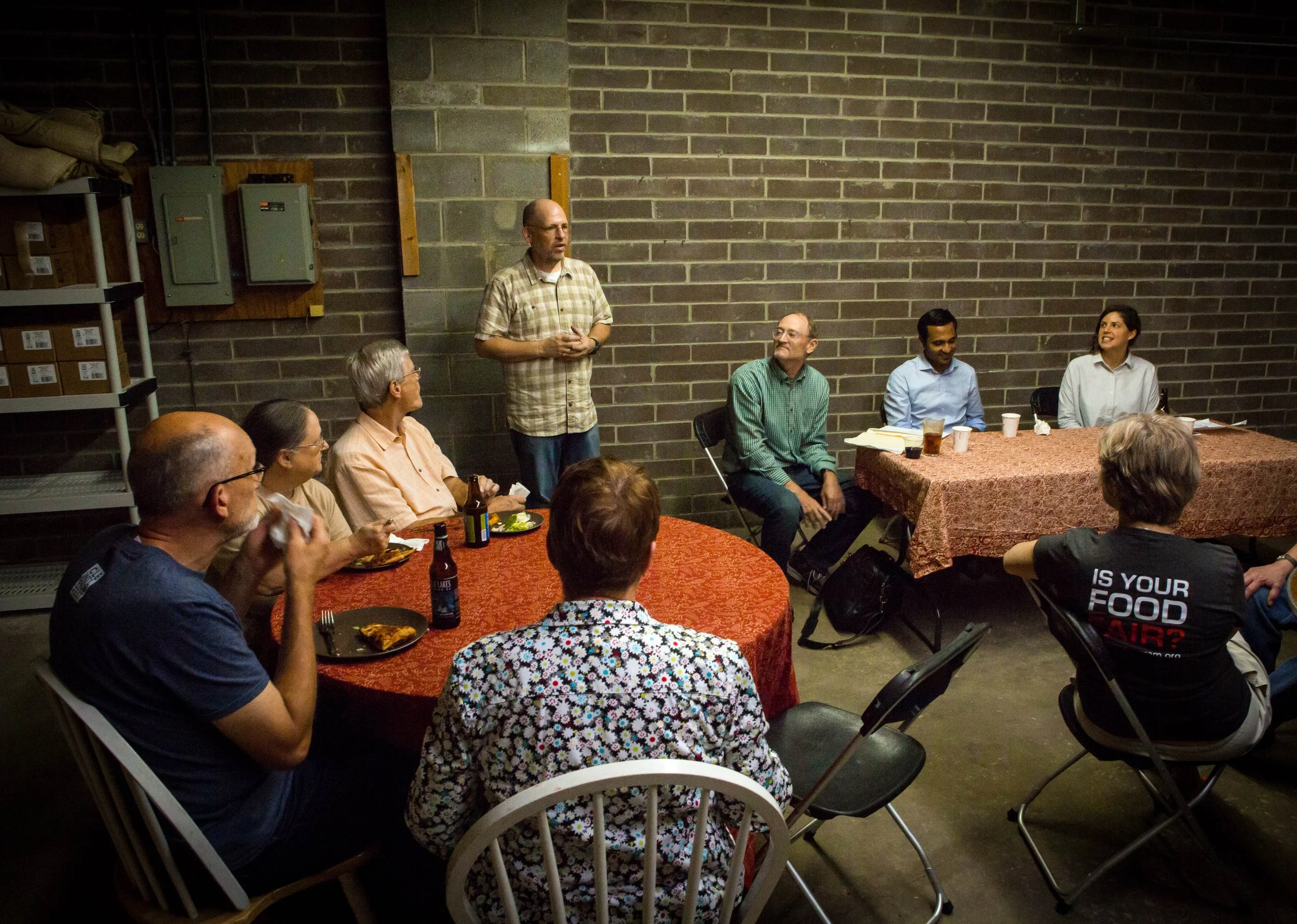
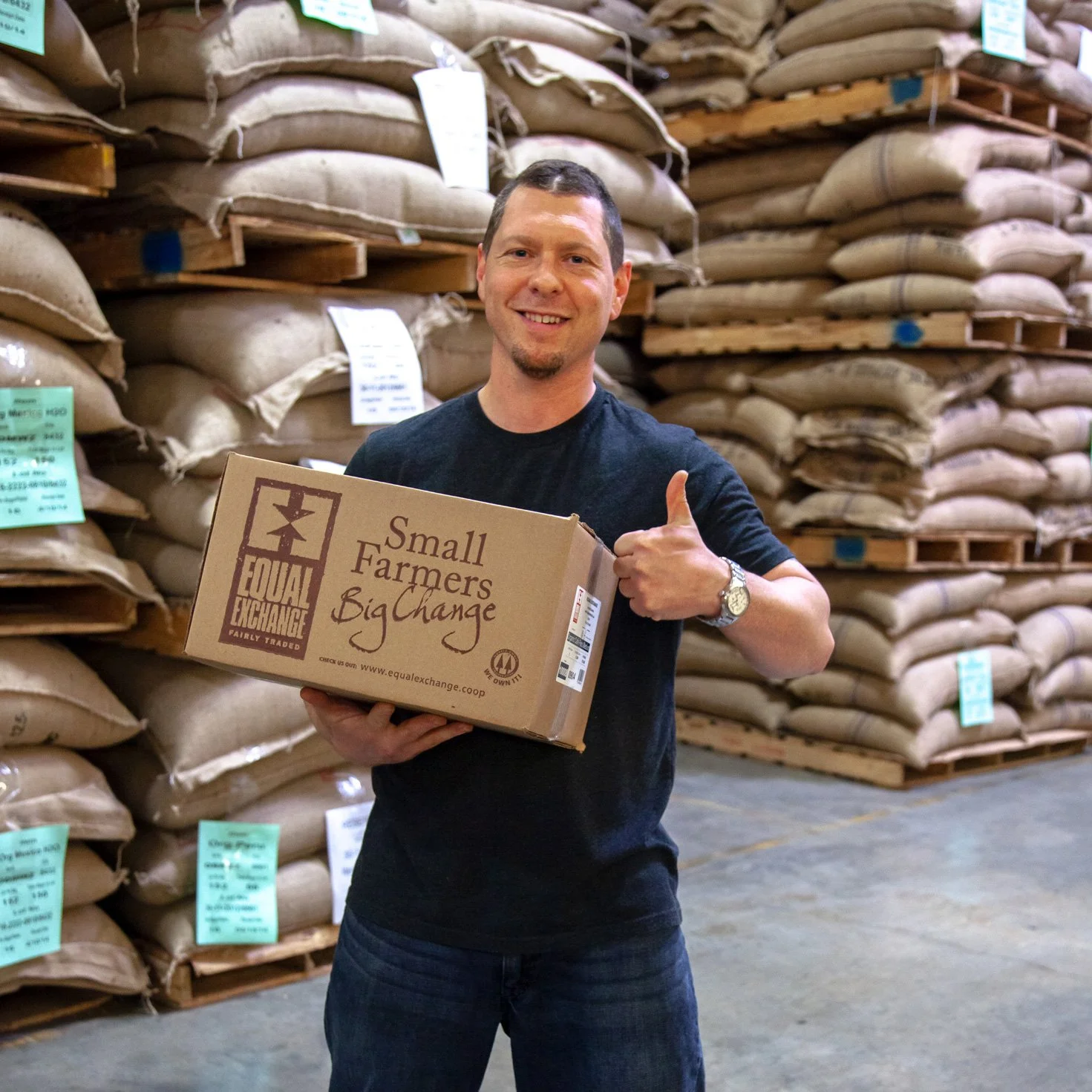
Above, left to right: Worker-owners gather for a meeting with Citizen-Consumers in Ohio; packing orders in West Bridgewater, Mass.
When action becomes unavoidable
Equal Exchange is many things. A coffee roaster, a partner to small farmers, a network of citizen consumers, and an alternative trader, just to name a few. But at the headwaters of these efforts is our core mission: to build a more just food system for farmers, consumers, and the planet. This inherently puts us into a political context. After all, to try and change the world, we must challenge the systems that govern it.
Over the company’s history, this has sometimes meant taking action—even when it might have been easier, and perhaps better for the bottom line, to stay on the sidelines. Equal Exchange has done everything from finding a workaround to the U.S. embargo on Nicaragua’s Sandinista Government to, just last year, starting the Small Farmer Fund in response to USAID abruptly breaking our contract for a multi-year co-op development grant. These efforts grew naturally from our core principles, which our worker-owners agreed upon and affirmed at key junctures through democratic processes.
“We’re a democratic organization,” said co-founder Rink Dickinson. “Our board is democratically elected; our membership is involved sometimes in very major decisions; we sell to a lot of democratic organizations that are food co-ops, and we buy from producer co-ops that are democratically organized.”
A strong worker voice
Equal Exchange’s founders, Michael Rozyne, Jonathan Rosenthal, and Rink Dickinson, met at Northeast Co-ops in the early 1980s. There, they saw firsthand how crucial it was to protect a strong worker voice through a democratically structured model. And so Equal Exchange built it into its operations from day one, and it continues to this day. Worker-owners occupy the majority of board seats, the company offers a high degree of transparency into its operations and finances, and major company decisions are put up to a vote.
“Supporting everyone’s right to have a vote, and those results being counted and never ever questioned once they’re counted, that's fundamental to what we have been doing since day one,” Rink said.
A democratic process is, by its nature, messy. By allowing a diversity of voices into the conversation, things can get chaotic; but it also prevents any single voice from taking over.
“We have a democratic organization here,” Rink said. “We listen to each other and we don't agree. So that's really important.”
The democratic model gives Equal Exchange a way to work through disagreements instead of being blocked by them. In fact, differences can help clarify what the present moment demands, with input coming from every level of the organization.
“I was a dreamer, and Equal Exchange allowed me to wake up dreaming,” Jonathan said. He then cited the well-known axiom from Sri Lanka's Sarvodaya Shramadana Movement, an early inspiration for the company:
We build the road, and the road builds us.
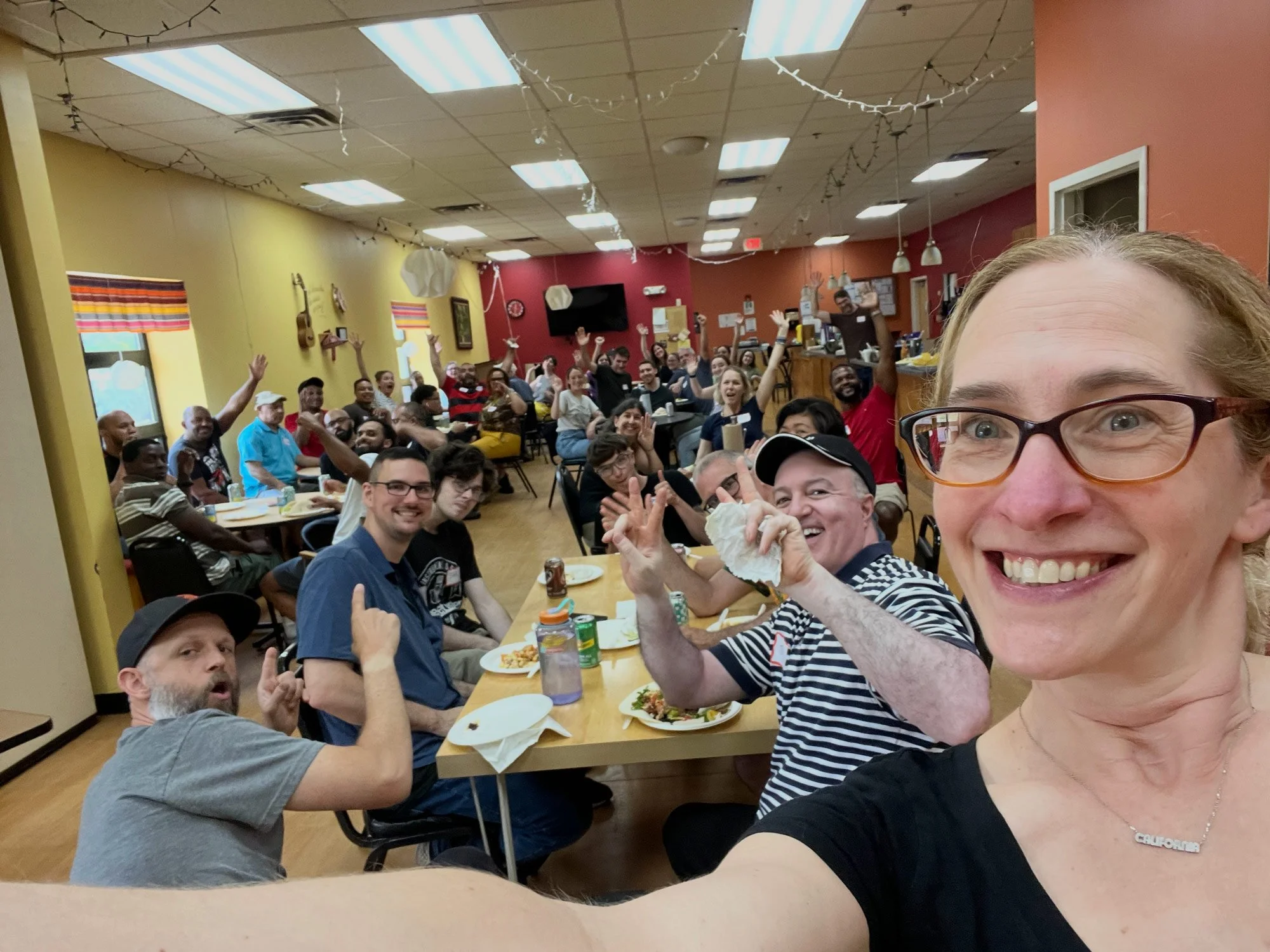
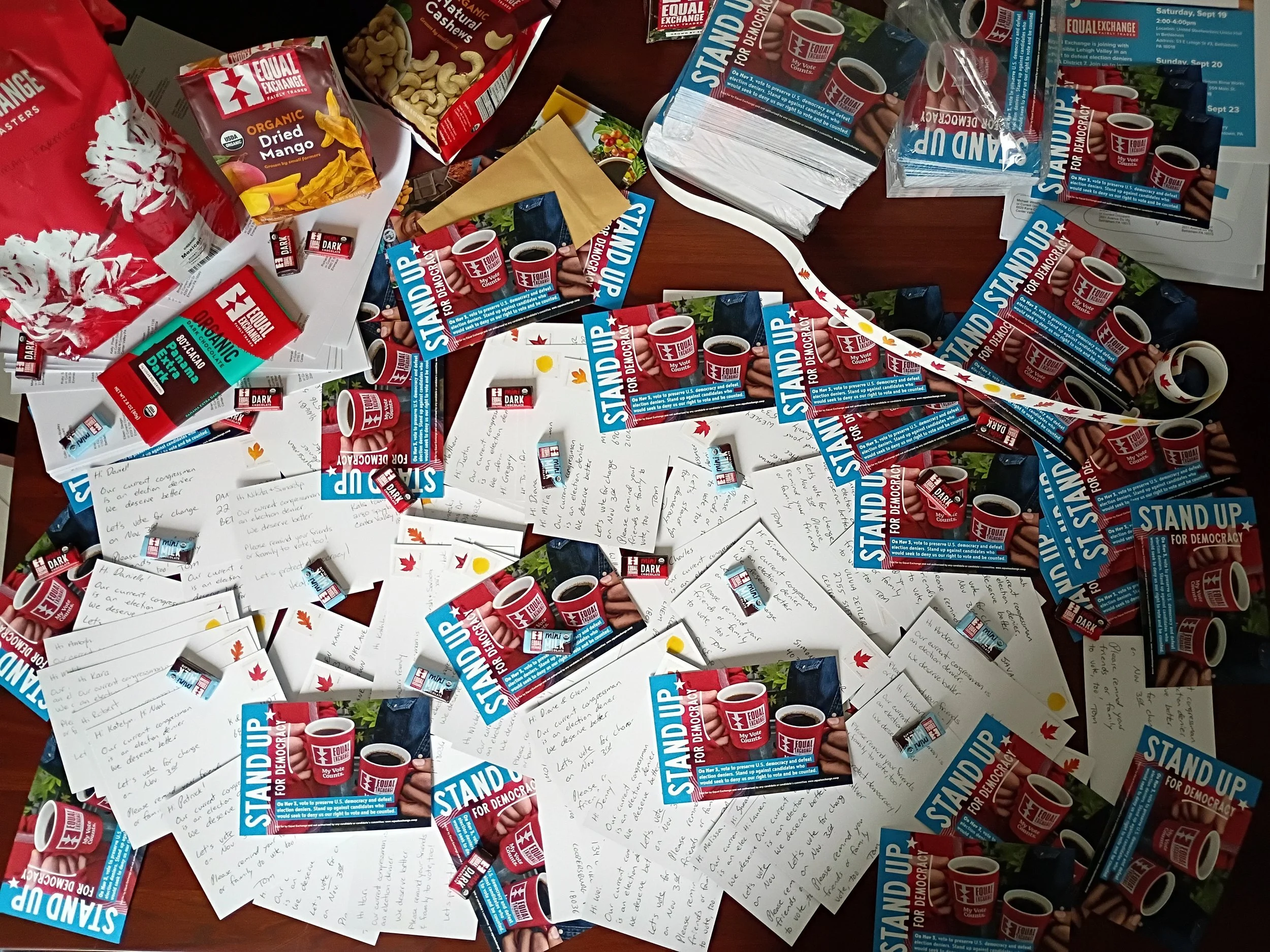
Above, left to right: Worker-owners celebrating our 40th Anniversary; a postcard writing campaign to vote out election deniers in the 2026 midterms.
Meeting the current moment
So how does a company like ours, whose mission is to change the way we think about, procure, and pay for our food, build the road and let the road build us? This is especially salient in a political climate where even citizens’ voting rights, the most basic tenet of our democracy, are under threat.
In short, we get off the sidelines.
“We didn’t get here easily,” Rink said. “There are many things that got us on this path. Ultimately, this is about democracy. We are a democratic organization that supports other democratic organizations. And we know the world needs what we're all here to provide. We need more democracy, more engagement, more citizen consumers.”
To that end, Equal Exchange decided it could not sit out the 2026 midterm elections. How did we come to this major decision? The democratic process, naturally.
“The worker-owners, the members of this cooperative, endorsed a few months ago the proposal to get involved in the elections this midterm for the first time ever,” said Rob Everts, a former co-executive director of Equal Exchange, who continues lending his skills to Equal Exchange’s organizing work. “We're only targeting districts where there is an election denier on the ballot.”
We don’t classify election deniers by party affiliation, but rather by a simple question: Do you recognize the 2020 election results for U.S. president, or don’t you?
“It cannot be denied that the entire U.S. democratic system is under a sustained, ongoing, and historical threat,” Rob said. “Look to your left and look to your right. Smaller institutions need to do this work. And Equal Exchange, as a democratic organization of some scale, has a role to play.”
Through a postcard-writing campaign, webinars, and in-person events that inform and encourage people to act, Equal Exchange has taken a stance many businesses, large and small, wouldn’t consider for fear of alienating or angering consumers, or drawing unfriendly attention from those in power. But we’ve never been like other businesses. From the very start, we’ve lived a political existence. Democracy and a passion for change sparked our founding and still fuel us today.
In the end, democracy is how we survive. It allows for discussion, conflict, and resolution. It provides a path for those of different ideologies, backgrounds, and positions to move forward. It shapes the people, and the people must continue to protect and shape it.
“We’re doing this because we feel we need to do this,” Rink said. “And we think other organizations need to do it, too.”