Rink Dickinson, Equal Exchange Co-Executive Director, recently visited our long-time customer Weaver Street Market, reflecting on the movement we’ve been a part of, our collective difference, and the need for continued risk-taking. Below, Equal Exchange Vice President Lynsey Miller threads together some of Rink’s key takeaways.
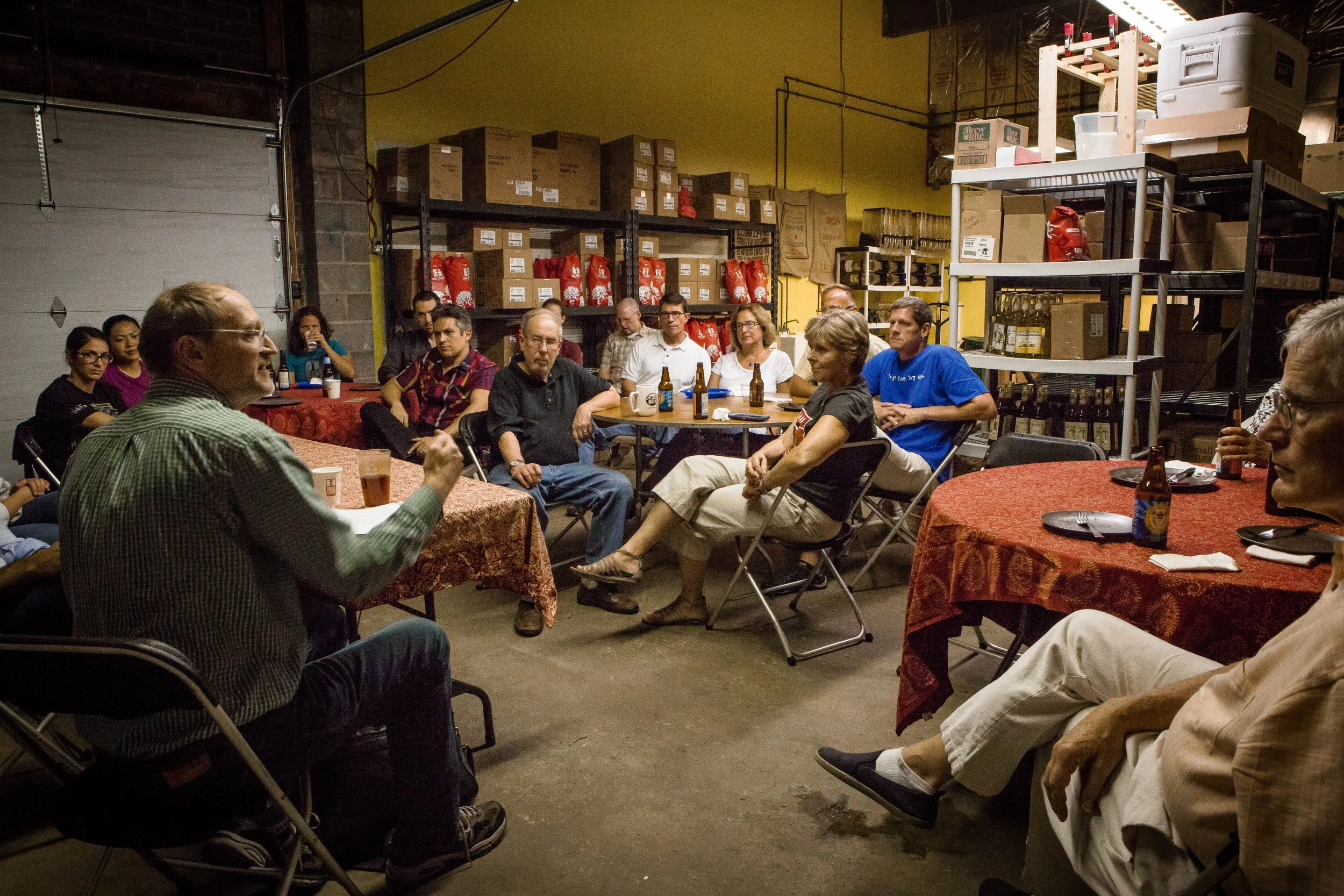
One of our first Citizen-Consumer organizing events in Cleveland, 2016. Rink is speaking on the left.
A global, local supply chain
Arguably, being in the middle of a supply chain is a powerful place to be. We are the link connecting farmers to consumers. In our alternative supply chain, we deliberately work with groups—co-ops of farmers internationally, and alternative businesses in the US—so that our collective actions don’t just benefit single individuals, but instead leverage hubs of local power to change local structures.
The Fair Trade model that Equal Exchange has been a leader in creating in the US has delivered really meaningful benefits to farmers, starting with coffee. More people are on the land. More people are getting a better price. More people have meaningful control.
All parts of our supply chain need each other. Farmers need ethical, fair buyers. Equal Exchange needs businesses that dedicate space for our products on their shelves—or in their cups! Consumers need farmers who not only grow the delicious products but also do so in a way that sustains the earth so that our future selves can still farm, trade, and eat these products.
On the US side of the equation, 40 years into this work, two contradictory truths exist: the food system landscape is bleak, and there is reason to hope.
Our customers are committed
Many conventional food corporations are sourcing in a way that’s a race to the bottom, seeking to pay farmers the least amount possible. At the same time, as shareholder or venture-capital-owned businesses, they are taking resources and profit out of communities in the US. The few owners profit at the expense of many. To compound matters, many of these corporations sell out to yet an even bigger corporation. Stores agglomerate. Power and profit concentrate in the hands of the few.
Since Equal Exchange’s founding 40 years ago, the mainstream food system around us has repeatedly pursued profit-prioritizing and power-concentrating goals. Equal Exchange and our values-driven network of partners built an alternative system, uplifting other priorities: inclusion, co-ownership, democratic participation, care for not just the end result but the experience and quality of the journey to get there.
We can’t compete with the conventional megacorporations on commercial terms. We have to be commercially viable, but we have to have a major difference, and win on that term. One essential difference that we have is our base of committed shoppers, who in some cases are also members and owners of their own community-based cooperative grocery stores. To keep our alternative model alive and creating impact, we have to activate—both individually as consumers and together with neighbors and co-members in our local communities—and build the next level that innovates new ways to connect our sub-communities nationally, to leverage our power on a larger scale.
And we have to keep taking risks
The more our members, Citizen-Consumers, and shoppers connect with the members of each of our food co-op partner stores, cafe-goers, students, and alternative trade supporters, the more we will share a collective, larger space dedicated to food justice.
Collectively, we need to show up, do our economic job, do our democracy job, have community, have fun, and disrupt the mainstream system that single-mindedly and effectively extracts.
One skill we have collectively built is the skill of taking risk. Disrupting the existing structures and building a powerful alternative has come as a result of an effective mix of vision and tactics that entail regular risk-taking.
If enough people believe their dollars will have impact, and if we have enough different, positive capital models, there is massive potential, and a unique moment of cultural appetite for our values. To bring a new reality into being, we need to test, experiment, push, build support, fail. Then adjust and repeat. Risk-taking needs to be not a solitary action, but more of a creative, disciplined approach. We must take risks as our individual organizations, while also finding shared risks to invest in together. Our network is uniquely positioned to pull this off.