Cooperation as a Worldview: Our Partnerships in Bolivia
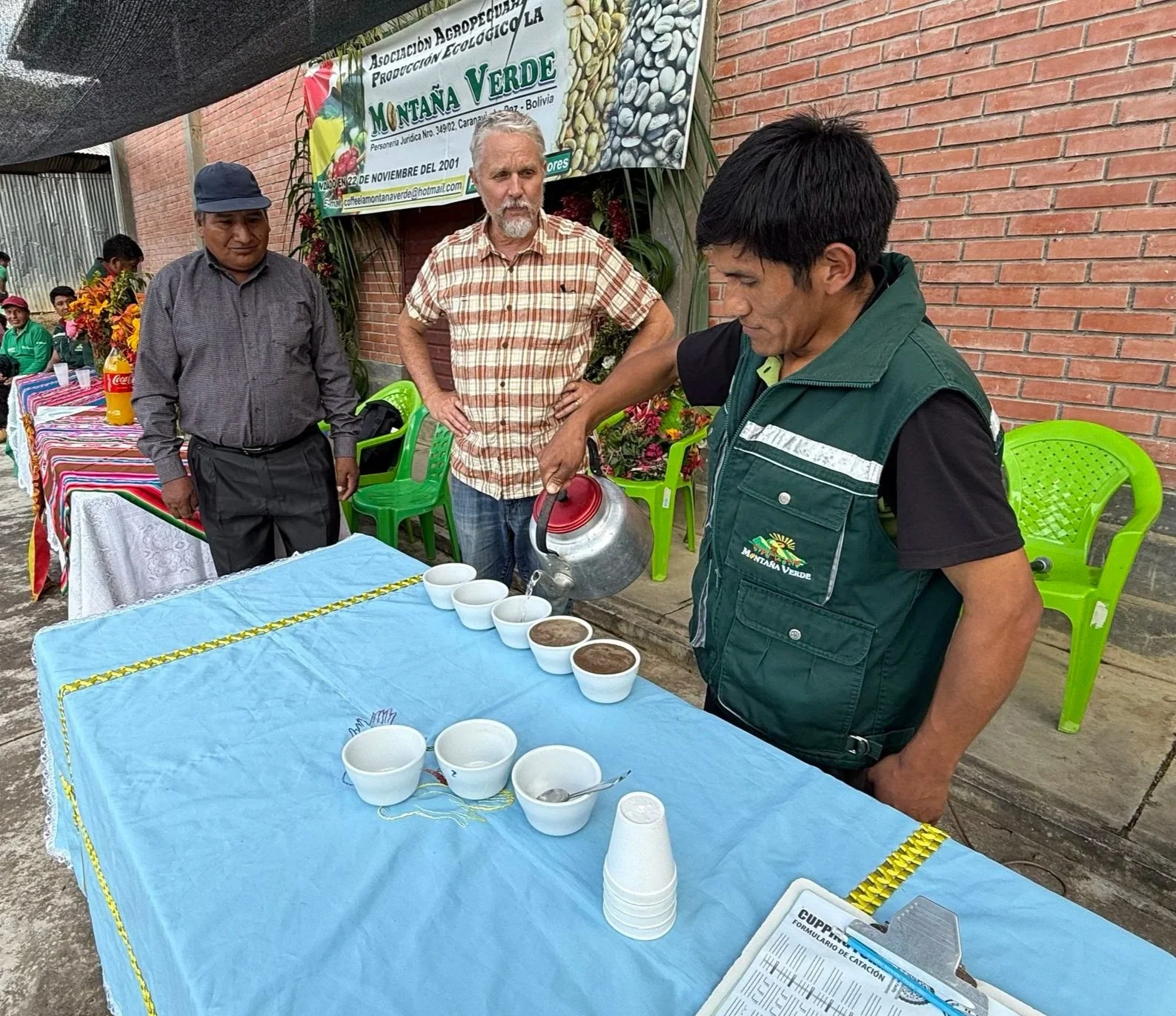
Above right: Domingo Mamani of La Montaña Verde with Todd Caspersen of Equal Exchange and local coffee cupper Iván during a coffee tasting.
Unbeknownst to many US coffee drinkers, the mountainous, lush Caranavi region in Bolivia is prized for its high-quality arabica coffee. Globally speaking, because this is a unique, limited cultivation zone, it can be hard to get your hands on this coffee to experience it. Equal Exchange has been sourcing in partnership with three coffee co-ops here for decades, and the quality of both the coffee and the relationships reflects this longtime investment and care.
Just like high-quality coffee, high-quality relationships are typically not happenstance; to the contrary, they are built intentionally and over time. Both Equal Exchange and our producer co-ops are committed to an alternative way of doing business that centers on fundamental values, including many related explicitly to coffee: high quality, organic cultivation, careful harvesting and processing techniques, and sustainable agriculture. But our partnerships have an additional layer of requirements that extend beyond the product, living out an equal dedication to how we do business together. Our business and theirs are deliberately structured as co-ops, meaning we also share commitments to an uncommonly high bar: transparency, democracy, social impact, and actions that build—rather than extract—collective resources.
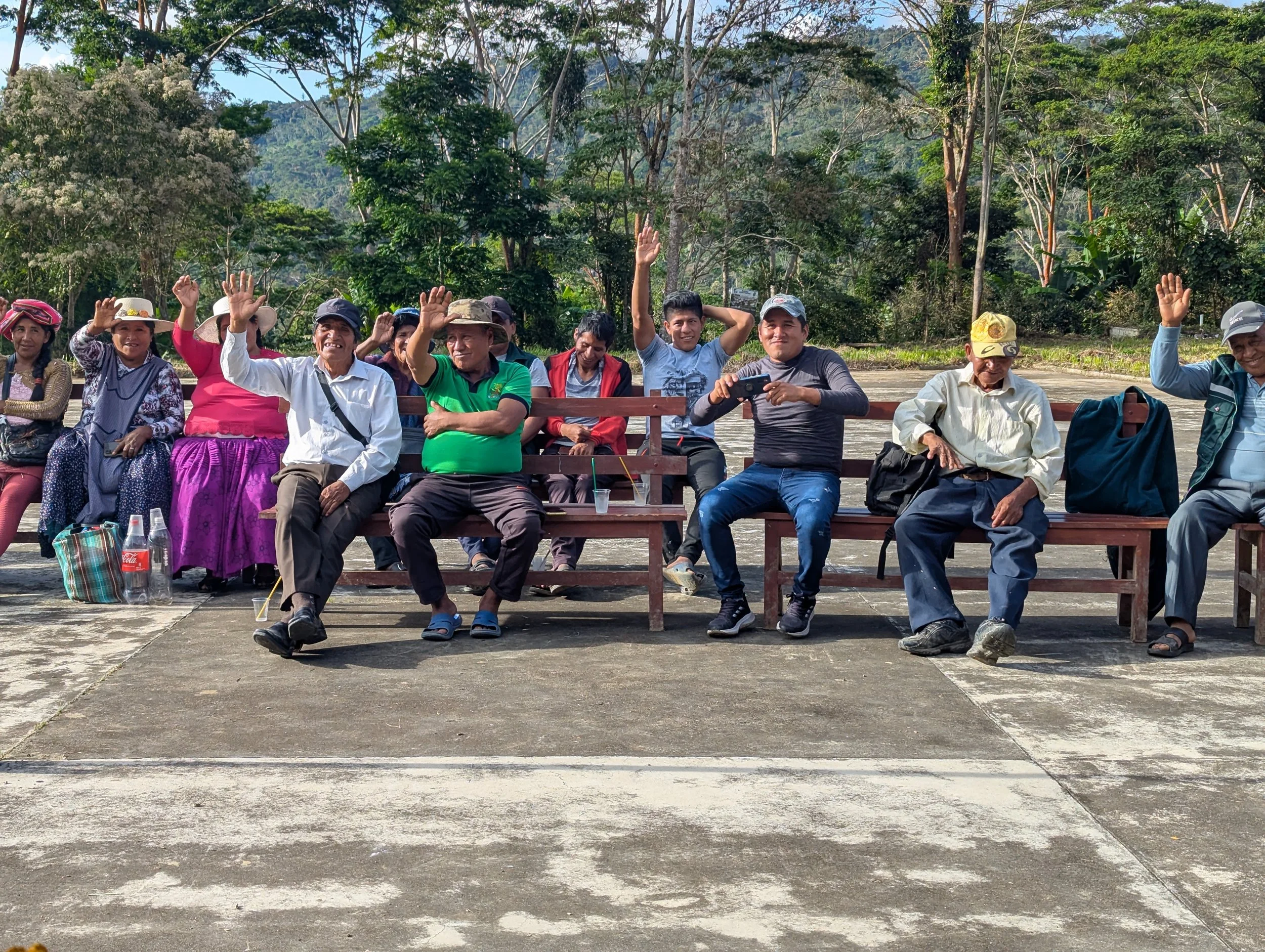
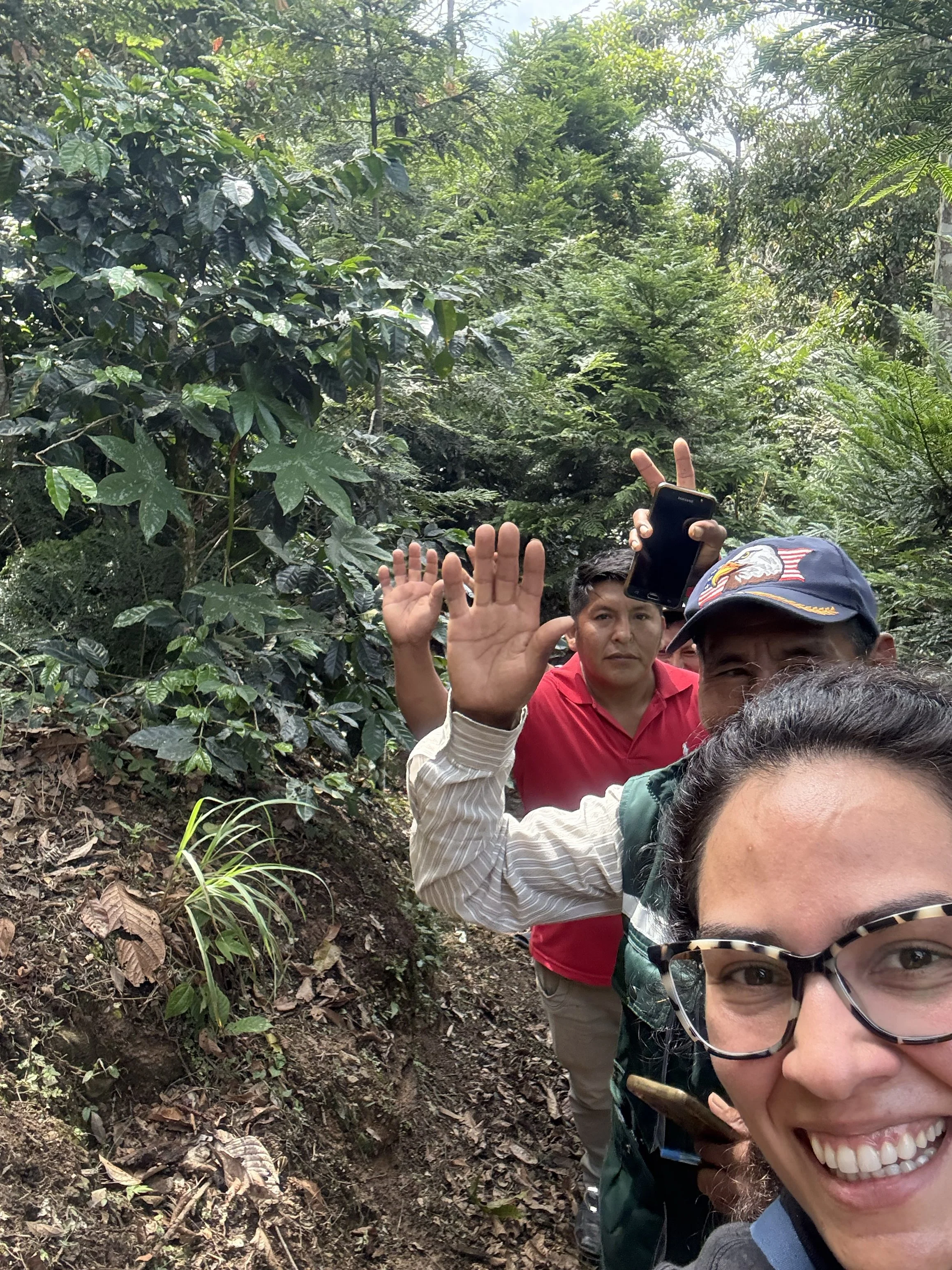
Left: La Montaña Verde co-op members take part in a community gathering. Right: Paola Coronado walks with La Montaña Verde cooperative members during a visit to a coffee farm.
Visiting our co-op partners in Bolivia
We structure some of our sourcing trips around specific trainings, events, or even mutual problem-solving. The goal of this trip was relationship-building. Unlike other coffee companies that source indirectly through importers, we source directly from farmer co-ops. As both a roaster and importer, we need to know the details of all layers—the coffee, the business, and the people. Certainly, regular communication occurs between our Sourcing Team and the farmer co-ops we trade with, but we also prioritize time spent in person in the farming communities. It is in these moments where both the farmer organization and Equal Exchange can share how business is going—what is going well, what are the challenges, what are the changes that we see coming. We spend time together on farms—in cupping labs, processing facilities, formal farmer-member assemblies, and in informal spaces like long car rides and farmers’ homes. These experiences build understanding and trust; as cooperatives, we face similar challenges, regardless of geographic context. From this strong foundation, we can, in good faith, engage in shared problem-solving and imagine opportunities: a new product, future training opportunities, or innovative projects.
Our coffee Sourcing Team of Todd Caspersen and Paola Coronado recently visited our three co-op partner groups in Bolivia: La Montaña Verde, Antofagasta, and Alto Sajama.
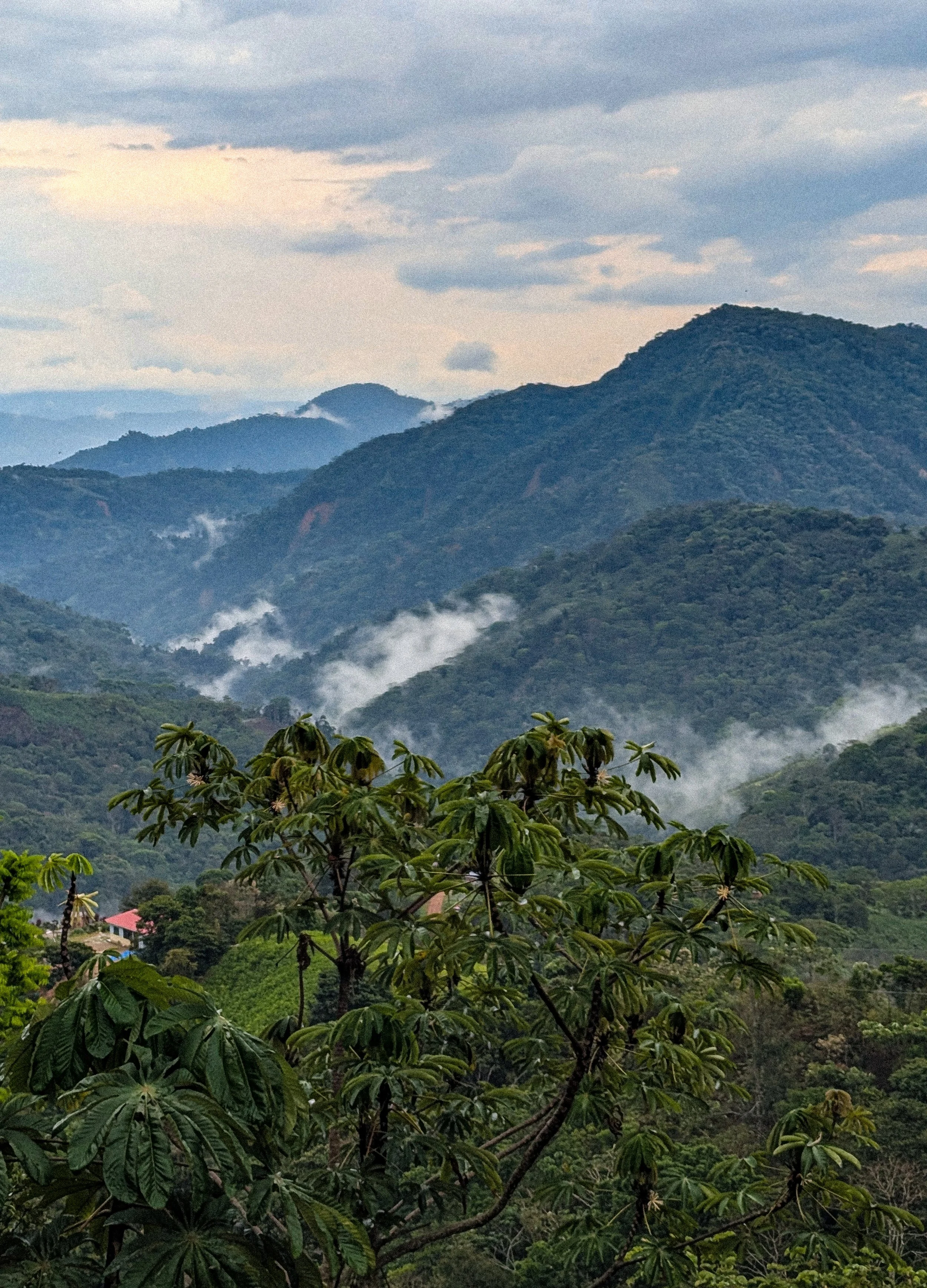
Todd, from North America, and Paola, from South America, began their Bolivian journey by meeting in Lima, Peru. Next, they traveled together to La Paz, Bolivia’s capital city. Notably, La Paz holds the record as the world's highest-elevation capital, situated at 11,942 feet—more than two miles—above sea level. From there, they set off further into the Amazon Basin into the Caranavi region. This area is special, and is sometimes referred to as the Ceja de Selva, or Eyebrow of the Jungle. Here, the misty Andes peaks and the Amazon rainforest converge, with a unique climate, geography, and overlapping ecosystems. These conditions make the Caranavi region ideal for arabica coffee cultivation. It is here that all three of our partner groups are based, far from most commercial activity and many government supports, but in relative proximity to each other.
As the trip unfolded, Todd and Paola noted trends emerging in their conversations with the co-op members. During the exchange, there was a great deal of focus on the future and on cooperation itself.
Future Focus
Organic farmers strive to hit a sweet spot: managing farms to deliver high-quality, abundant crops for the current harvest season without compromising future successful harvests. Much of their investment serves double duty; for example, investing in soil health helps both this harvest cycle and future cycles. But sometimes current and future harvests are at odds with each other. When should a farmer remove older trees that no longer produce as much as they once did and plant new ones? The future return is that newer trees will produce at good-to-great levels in future years, but the short-term loss is that these trees won’t fruit for several years.
Farmers at La Montaña Verde co-op now address this tension through a planned approach, implementing staggered replacements. Some farms have up to five distinct “age groups” of trees on one farm. This is an impressive solution that essentially both systematizes the commitment to future harvests and spreads the replacement, called “renovation,” across a longer time horizon. In this co-op, farms are dynamic and in a constant cycle of newer trees coming online as older trees gradually produce less. At the same time, by staggering the negative impact of lost productivity from new trees, farmers avoid a future year when low output would hit all at once across a majority of their acreage.
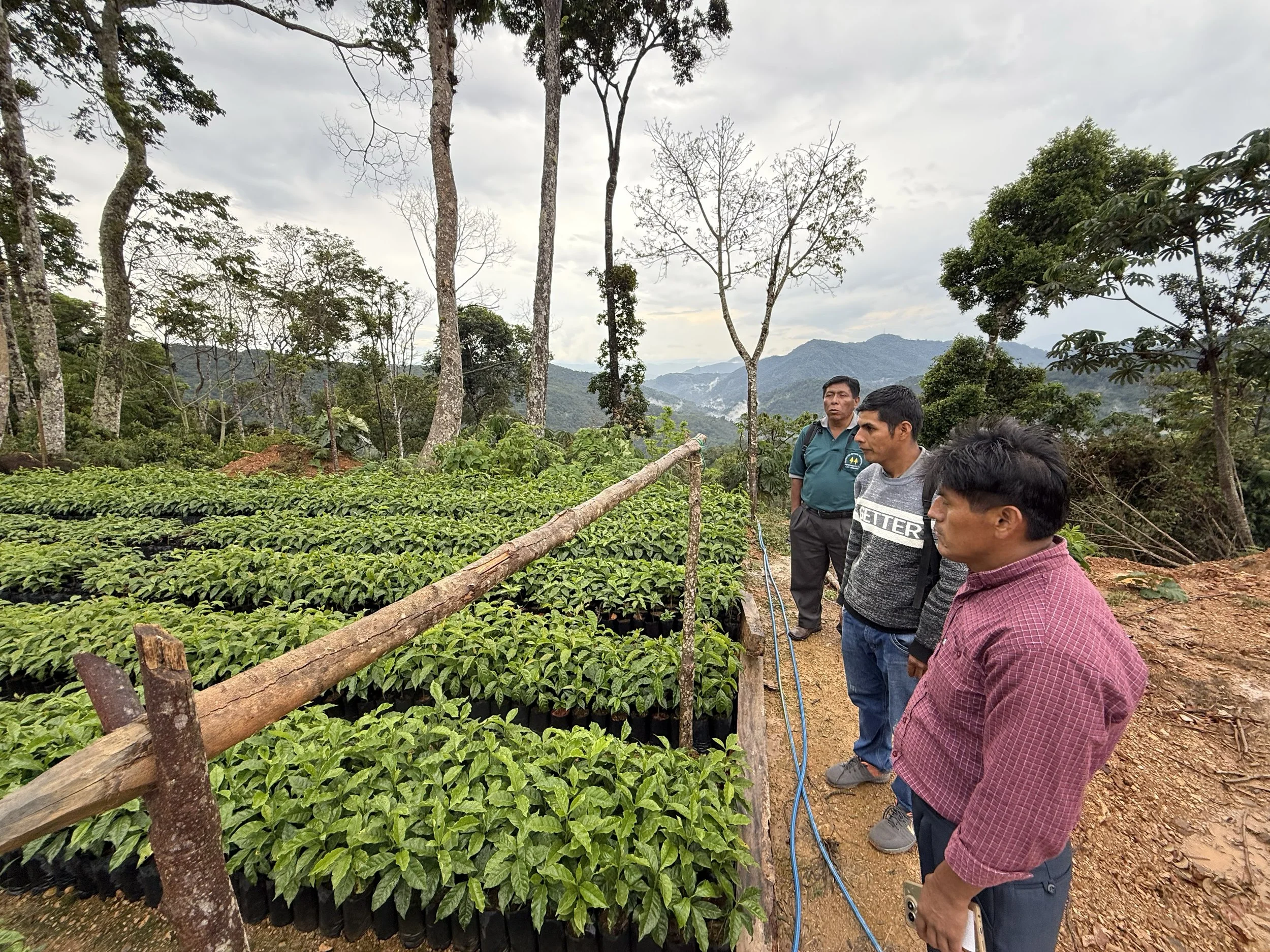
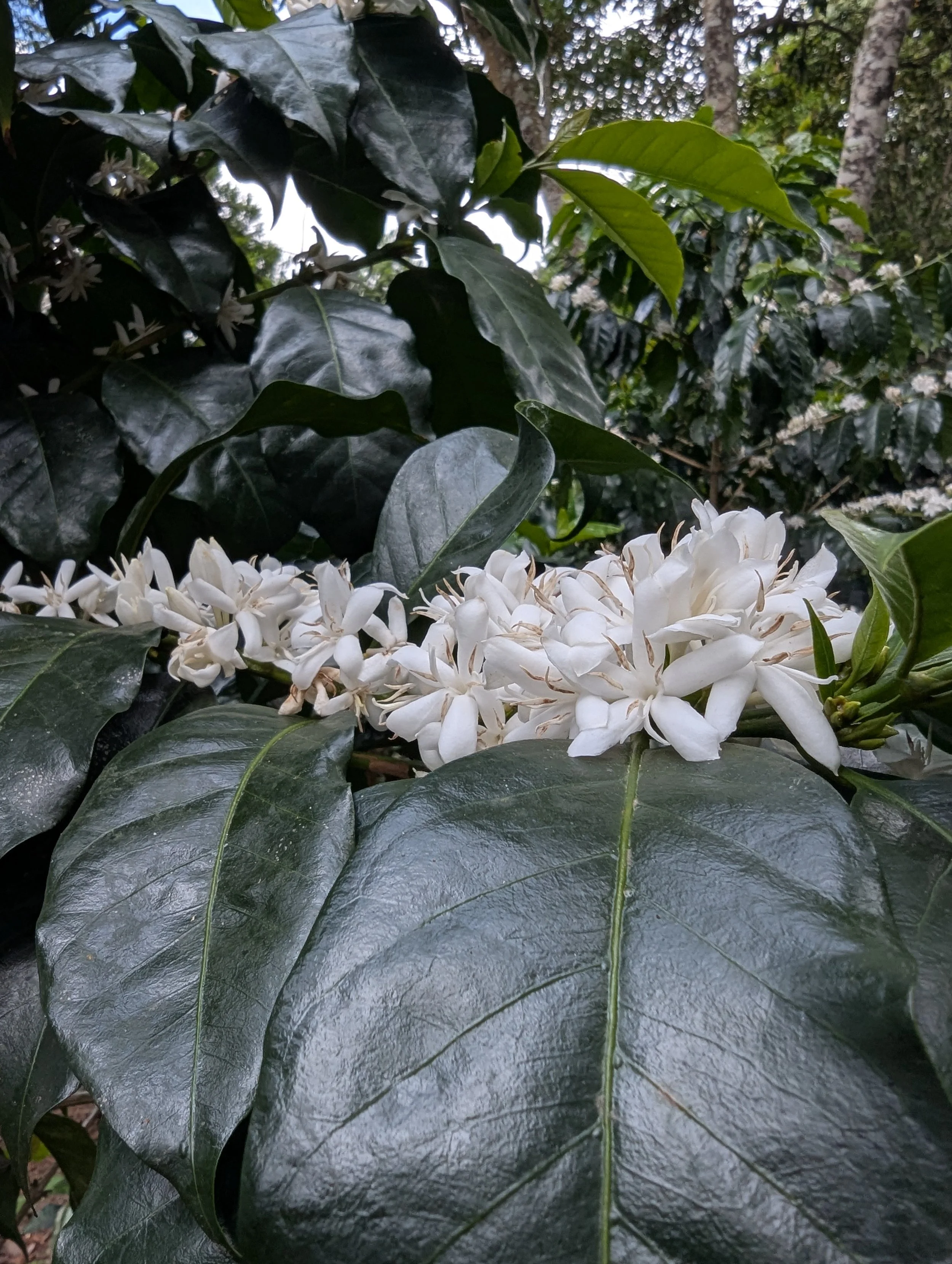
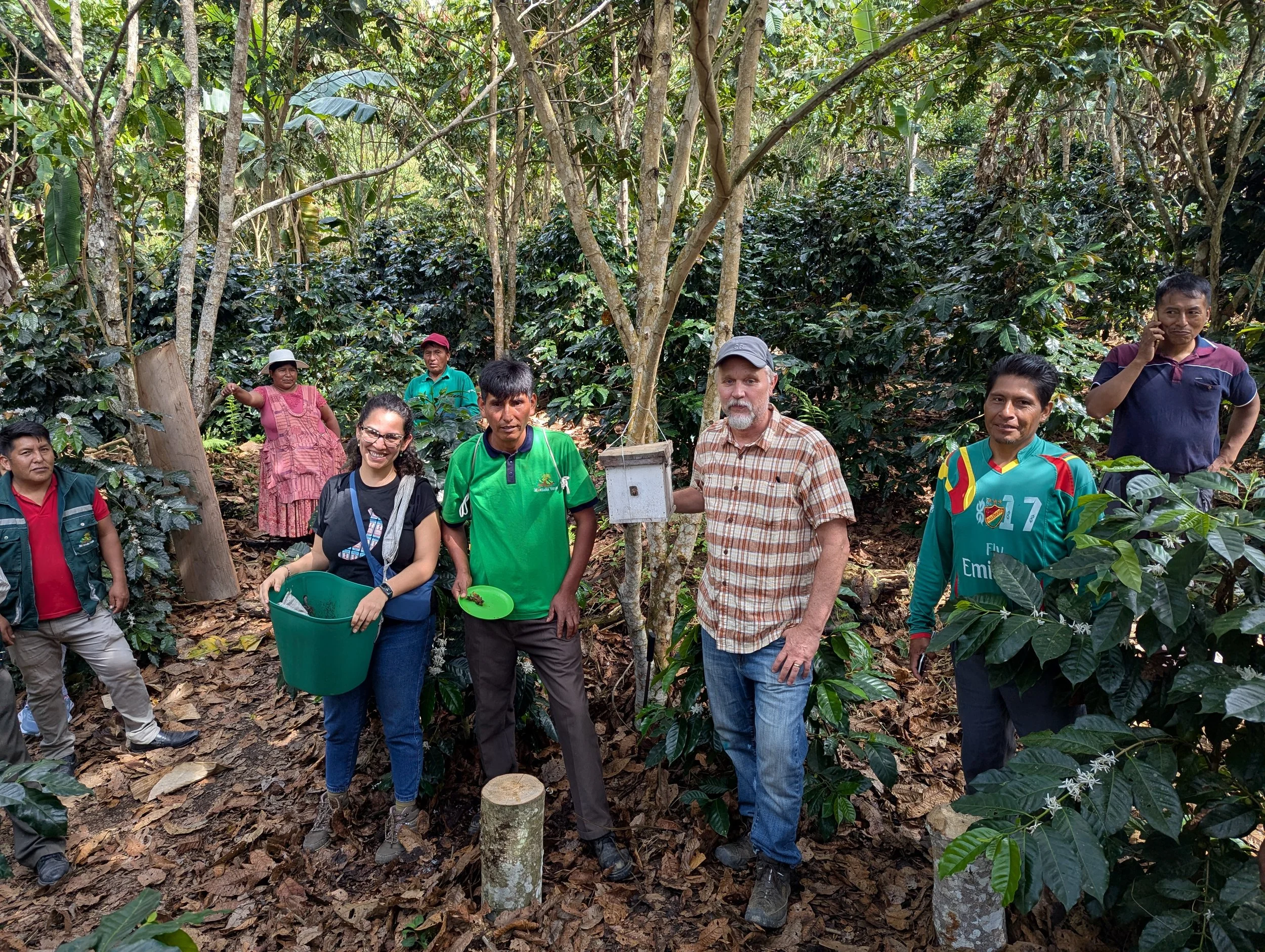
Top left: Young coffee trees being raised at an Alto Sajama co-op plant nursery. Top right: Coffee trees flowering. Above: Montaña Verde member Marco Peralta presents honey from his stingless bees on his agroforestry coffee farm.
Equally important to the pursuit of long-term farming is investing in the human parallel: different “age groups” of humans! Many farmer organizations across all sorts of crops are concerned about the flight of young people out of farming communities. These are fundamental questions that impact individual family farms, farmer co-ops, and conscientious eaters wondering who will grow our future food.
Our Bolivian farmer partners have succeeded in incorporating young farmers into the membership. Todd and Paola met several of these young farmers who were engaged and whose farms modeled progressive techniques, including the staggered ages of trees, a variety of species of both coffee trees and shade trees on farm plots, and native species beekeeping, which helps pollinate all manner of plants, including coffee, leading to higher productivity and harvest yields.
Land is a valuable commodity in farming communities. Arable land is limited within these fertile areas, and as land has changed hands with the turning of generations, the co-ops here have helped the land stay in coffee production and have supported newer farmers getting their footing through access to best practices.
Cooperation as an organization and as a worldview
Most of the coffee farm co-ops we visit are remote, up steep mountainsides, with limited state or government support. Communities often have limited access to even essential needs like health care services and education. The co-ops themselves become the community institutions with the vision, community buy-in, and resources to create those services for members. In the case of our Bolivian partners, the co-ops have turned this dynamic a bit on its head. They lobbied the government to fund and build a state-of-the-art coffee research facility in their communities, and succeeded.
While still in the construction and staffing phase, and therefore not yet operational, this coffee research institute will host all manner of useful research and experimentation, ranging from soil and water analysis to cupping labs to the study of over 80 varietals of coffee. This kind of well-funded coffee research facility is rare. La Montaña Verde had the foresight to actively recruit this facility to be built in their backyard, using strategic methods like donating some of their communally-held land to help convince the institute to locate in their area. The proximity will enable these small farmer co-ops to benefit from the facility’s work. One would also like to think that researchers might benefit from witnessing the innovative organic practices and collective working model of these small farmers.
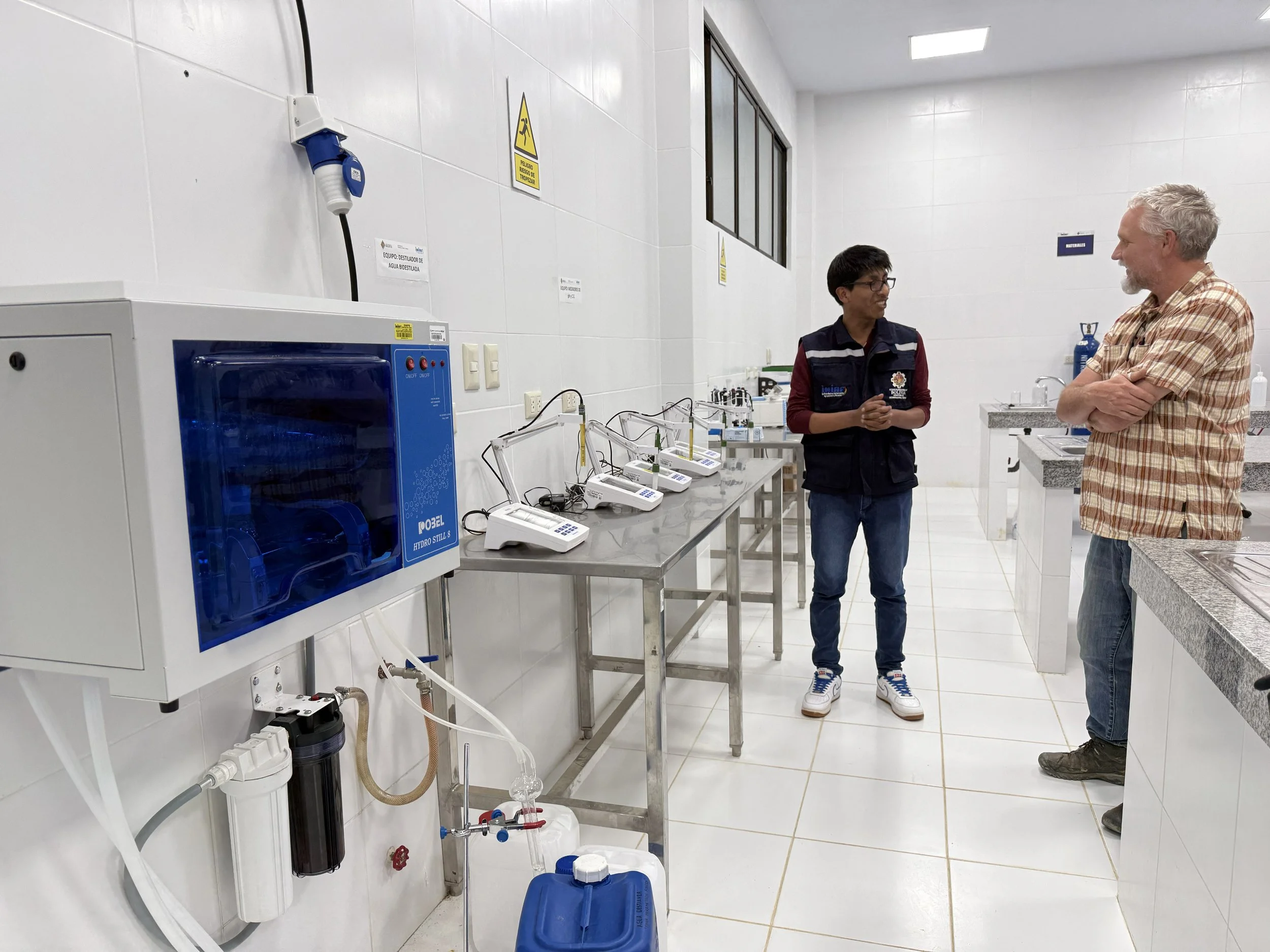
Todd speaks with the water analysis specialist at the National Institute of Agricultural and Forestry Innovation near La Montaña Verde.
By nature, a cooperative is born to meet the collective needs of a group. It is owned collectively, and many of the profits and resources are shared, often through democratically determined processes set by the farmer members. And yet in Bolivia, collective work functions on an elevated plane.
Bolivia has a thriving indigenous tradition called “ayni,” a word from the Quechua and Aymara indigenous languages used by the farmers, which means “today for you, tomorrow for me.” The word describes a larger cultural perspective of mutual respect and reciprocity that was clearly visible during this exchange. One example of how that translates into the farming activities is evident in the spread of food at co-op events. The co-op does not cater meals; instead, each farming family contributes food so that all may enjoy the result of small but cumulative contributions by everyone. Another example is during the coffee harvest; farmers get together and jointly harvest the coffee plot of one family. They then move on together to the next. Instead of each farmer harvesting their own plots simultaneously but in isolation, harvesting becomes a community affair, with friends and neighbors. This critical step in the annual cultivation cycle is done with the help and love of fellow and sister co-op members.
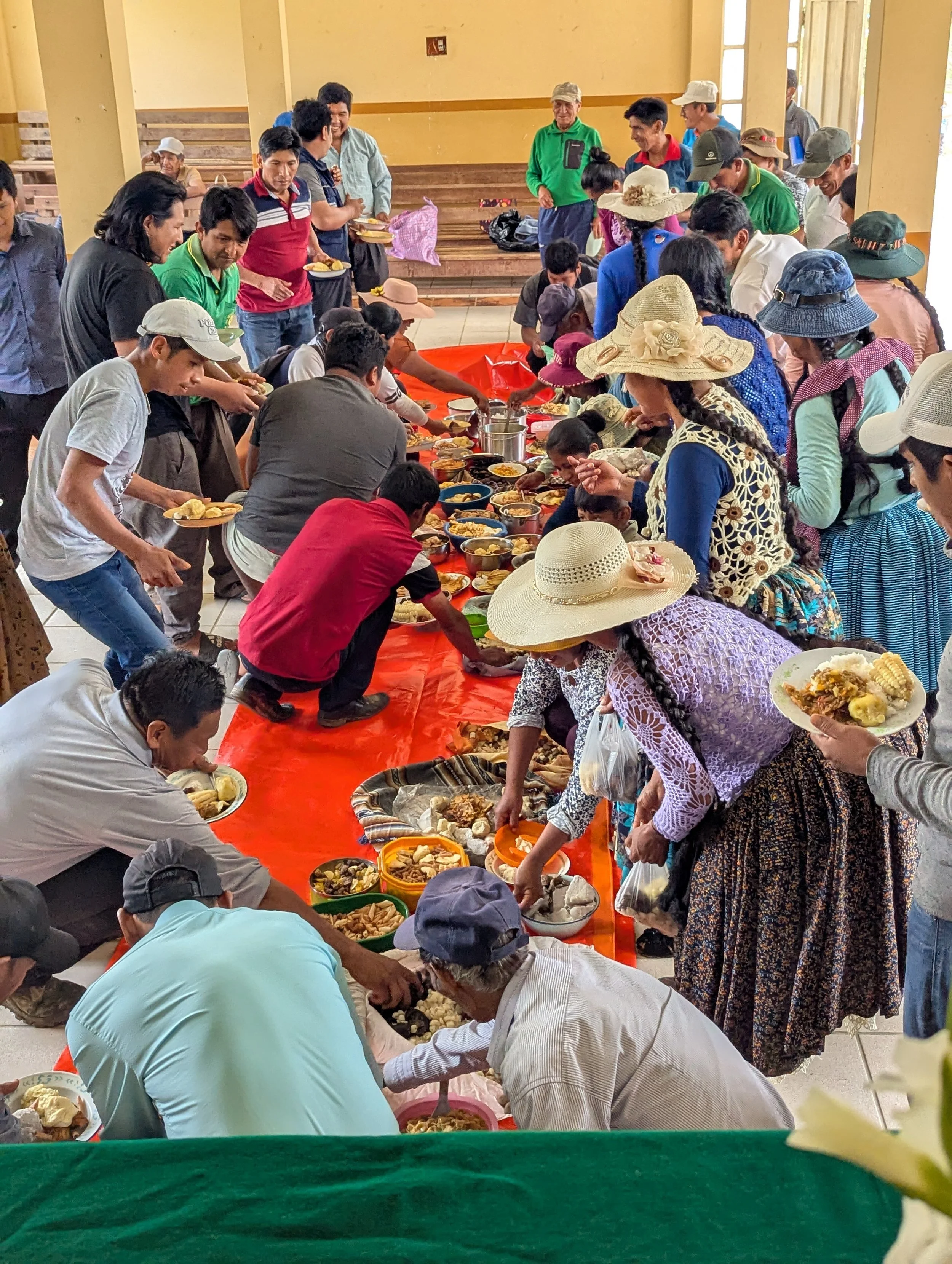
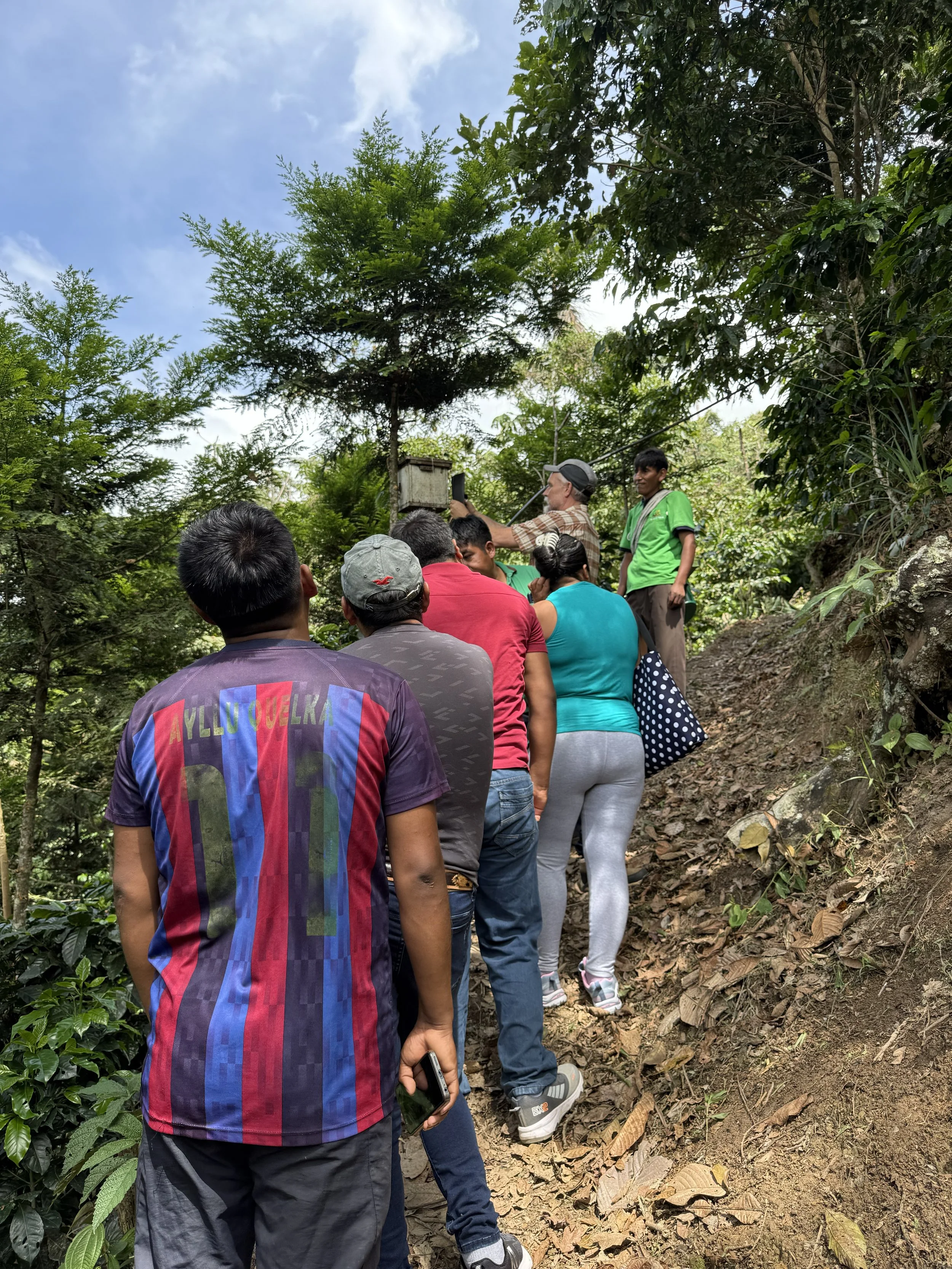
Left: Families from Alto Sajama and Oro Verde co-ops gather to share a traditional communal meal. Right: Members of La Montaña Verde walk together on the way to Marco’s coffee farm.
Coffee is the engine that fuels the relationship between Equal Exchange and these farming communities. In this case, the end product is delicious. But that’s just one of the tangible results; the true value and impact extend far beyond the cup, into connection, community, and future-thinking.