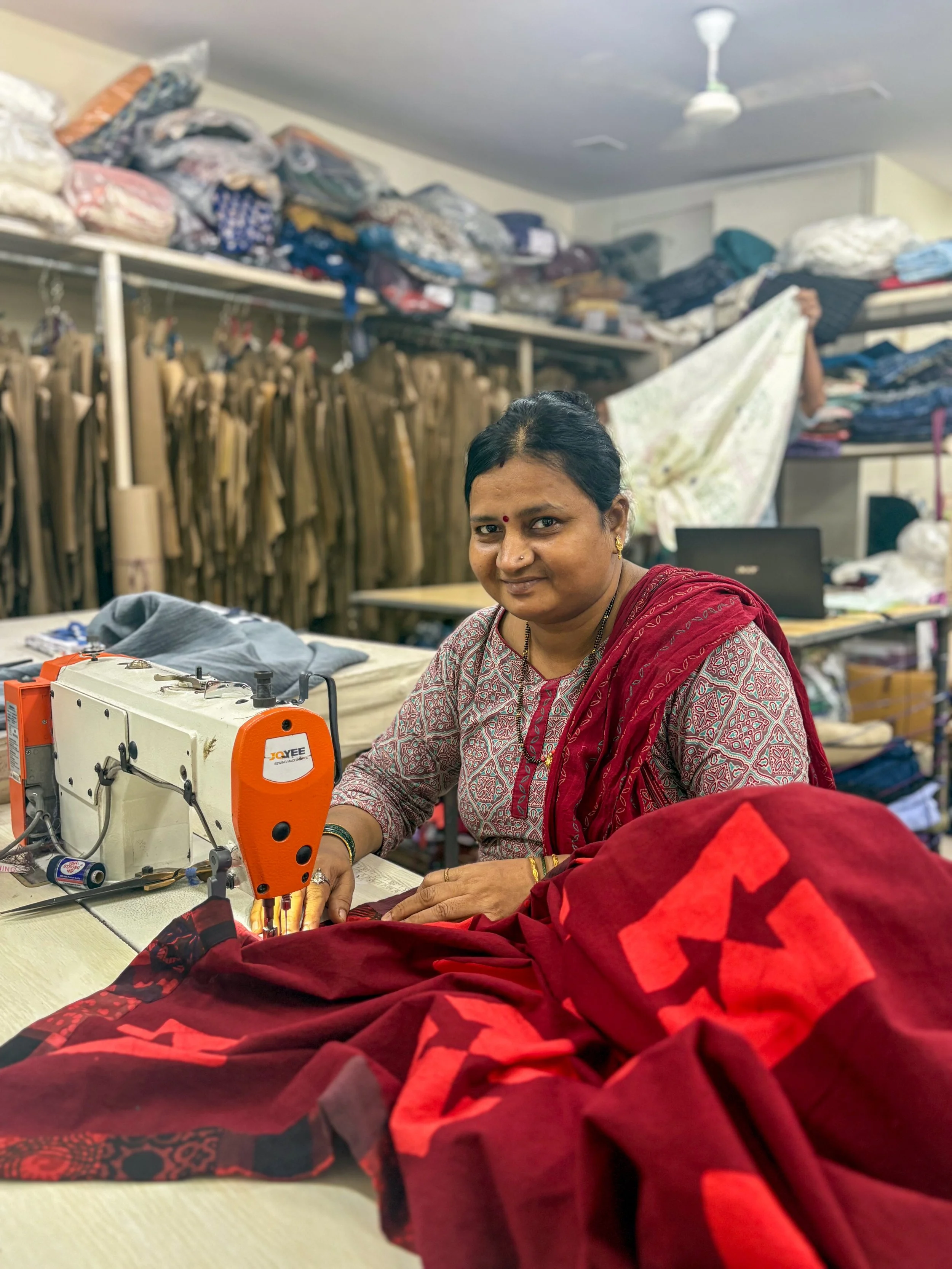
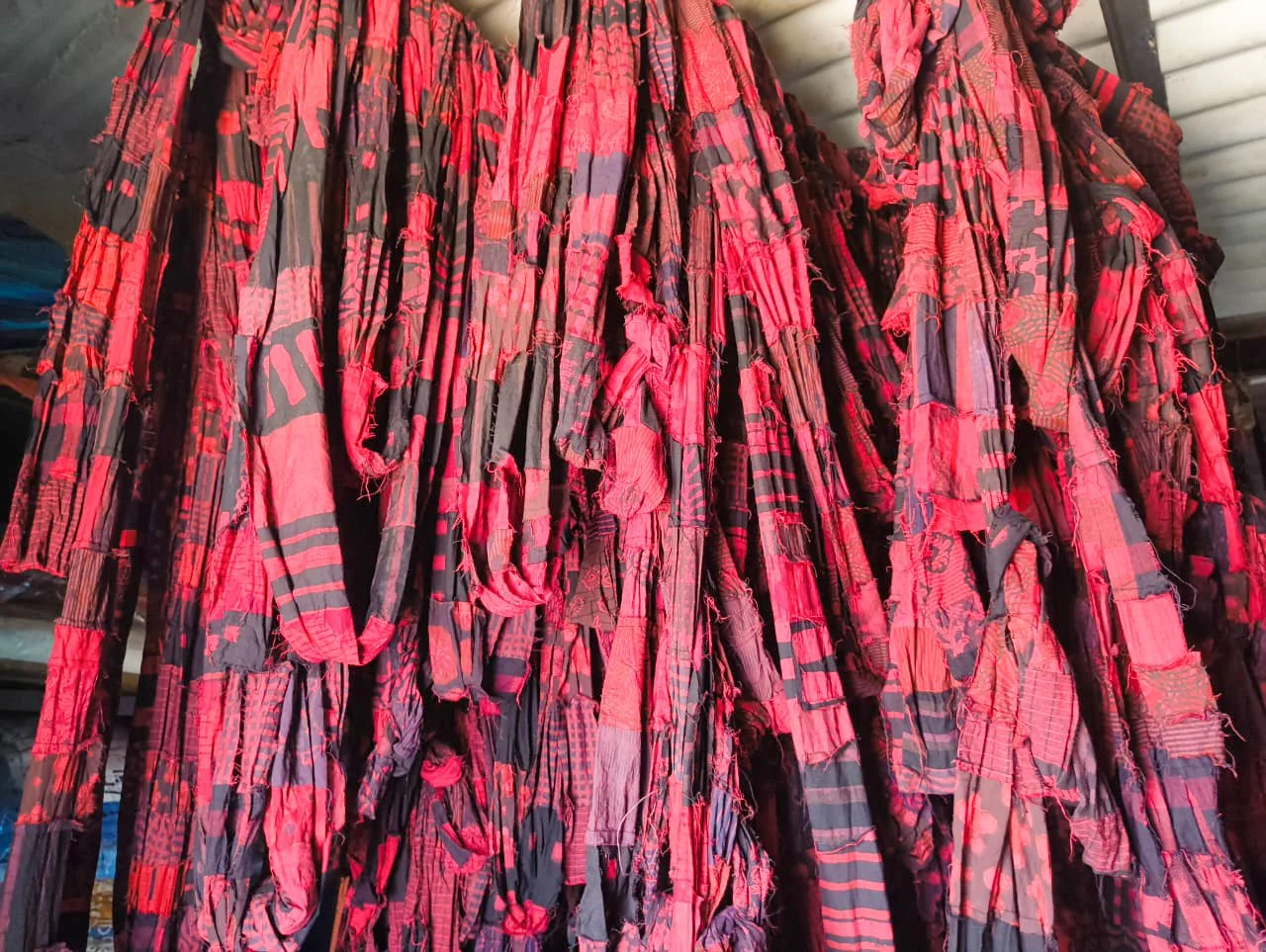
Above, left to right: sewing the chindi border on the Equal Exchange logo tablecloth; overdyed tablecloth borders hanging up to dry.
The integrity of handmade goods
If you’ve ever run your hand over a handmade cloth and noticed the pattern isn’t quite perfect, you know the look of work done by hand. These variations highlight the uniqueness of each piece and the care and work artisans a world away put into these textiles. The block printed and block batik patterns on our new tablecloth and napkins, made with our longtime partner MarketPlace: Handwork of India, are made stamp by stamp, with no machine involved.
Block printing and block batik
Block printing and block batik are among the oldest ways of putting a design on cloth, and India has practiced each method for centuries. Both use a hand-carved wooden block that works like a rubber stamp, but requires far more patience. The difference is what the block carries: dye for block printing, wax for batik.
In block printing, the carved block is pressed into dye and stamped directly onto the cloth. Batik works in reverse, by blocking off areas the dye color won’t reach. Here are the steps involved in batik:
Carving: A craftsperson carves the pattern into a block of wood, leaving the design raised. It’s skilled work, because the accuracy of the carving is the first key to a good print.
Waxing: The carved face is dipped into hot wax, then set down on the fabric.
Pressing and repeating: The printer taps the back of the block so the wax transfers evenly, then lines it up with the last impression and stamps again. Printers do this by eye and feel, thousands of times over a length of fabric.
Dyeing: The cloth is dyed. The dye can’t reach the waxed areas, so the stamped design remains free of color.
Removing the wax: The wax is washed in very hot water, revealing the design—in this case, Equal Exchange’s trademark arrows—in the cloth's original color, contrasting beautifully against the dyed background.
Nothing in this printing process is done by machine. That’s why you may notice a slightly lighter stamp, or a line that sits a hair off from its neighbor. Those aren’t flaws. They’re proof that a person made this cloth, and no two pieces are exactly alike. Our tablecloth carries the Equal Exchange logo, with its two joined arrows, carved and stamped by hand.
The patchwork border: what is chindi?
Around the edge of the Equal Exchange logo tablecloth runs a chindi patchwork border. Chindi is a Hindi word meaning scraps, and chindi work gives leftover fabric from sewing garments a new use while keeping it out of the landfill. Offcuts that might have been thrown away are sorted, arranged, and stitched together into something colorful, and every border is slightly different. It’s a sustainable, thoughtful way to work with fabric.
The hands behind the cloth
MarketPlace: Handwork of India is a nonprofit Fair Trade organization based in Evanston, Illinois. It works with several hundred artisans, most of them women, organized into independent cooperatives. At its heart, MarketPlace is about empowerment. Women who would not normally find work in the open job market build skills in both craft and business, and many go on to become leaders in their cooperatives, their homes, and their neighborhoods. The fabric artisans who batik and block print the cloth are small, family-owned businesses. Founder Pushpika Freitas describes the guiding idea as dignity, not charity.
The impact reaches well beyond the artisans themselves. Research on MarketPlace’s artisans found that these women contribute, on average, 40 to 60 percent of their households’ financial resources. A fair price for handwork means steadier income for a family, and education that gives the next generation more choices.
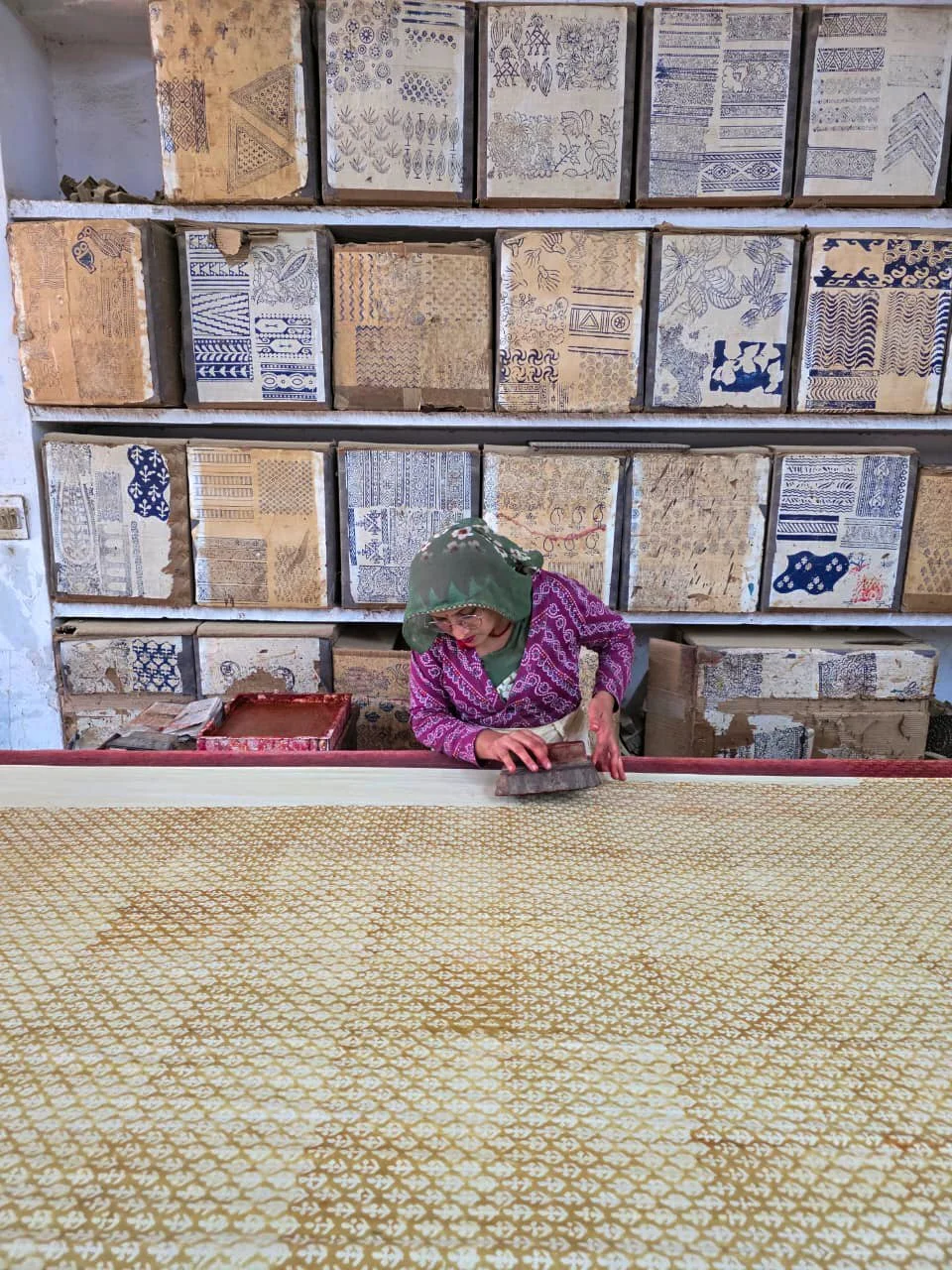
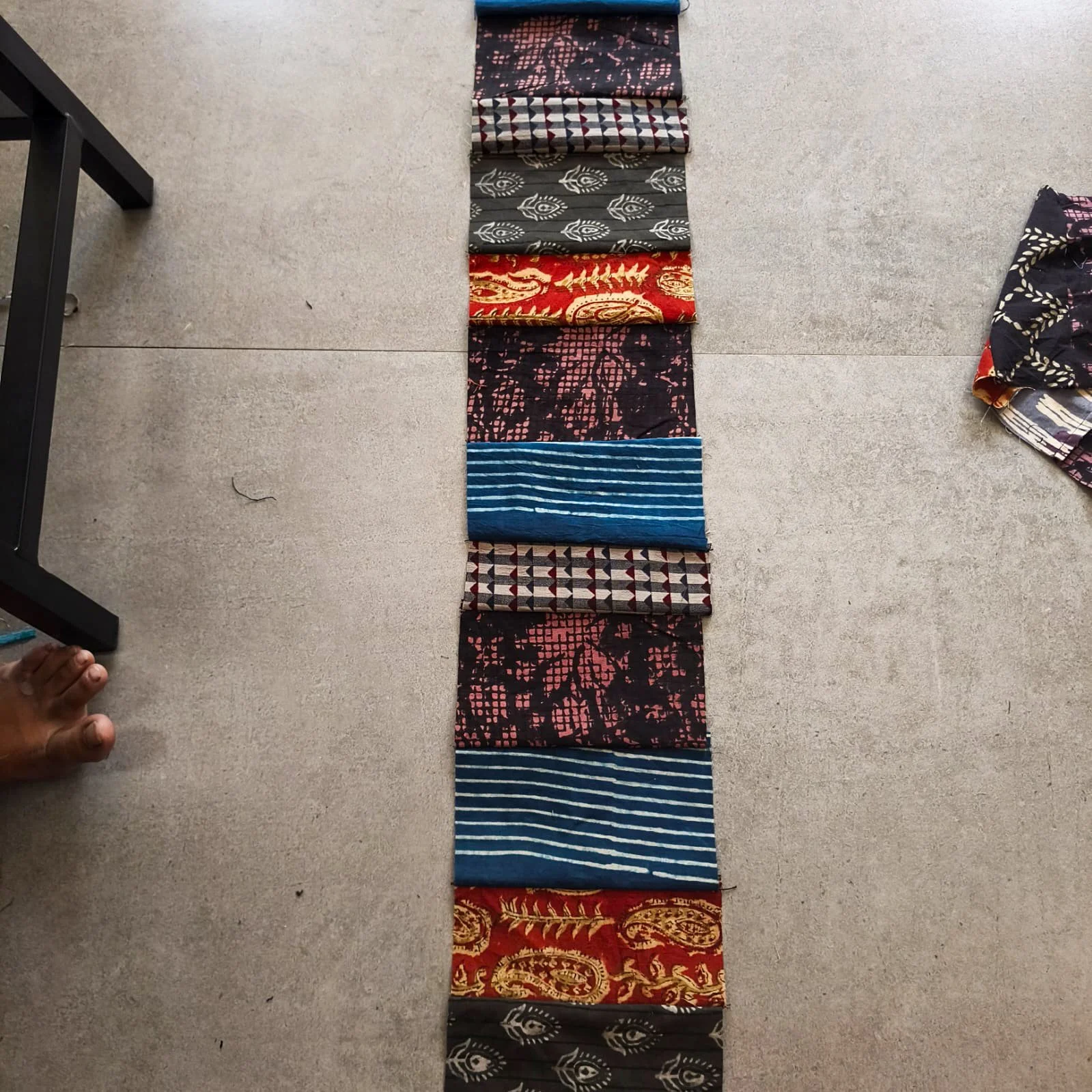
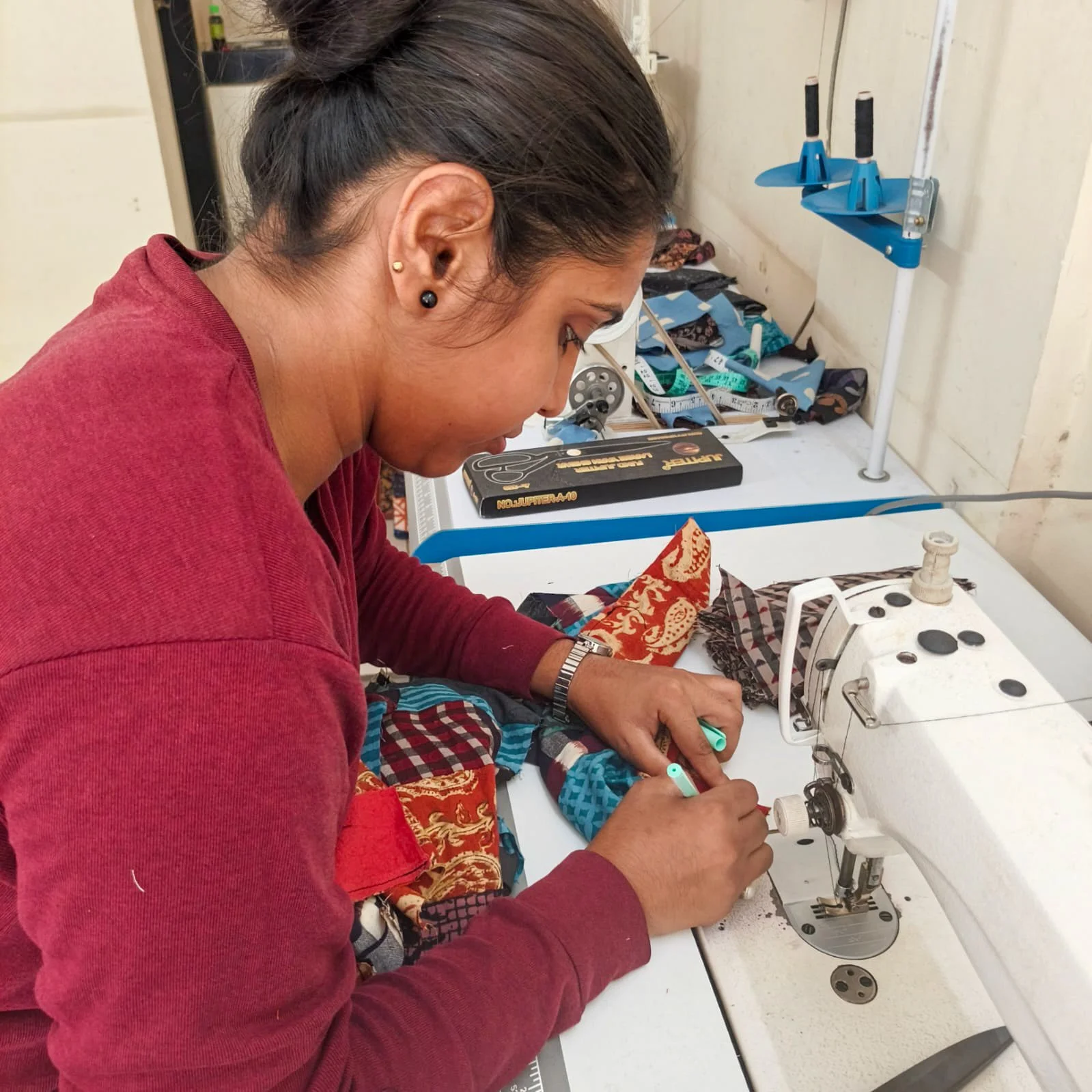
Above, left to right: stamping cloth for the Russet Floral Blockprint Napkins; an example of chindi fabric sewn together to make the tablecloth border; sewing the chindi border.
A partnership as old as Fair Trade in the U.S.
Equal Exchange and MarketPlace share a birth year. Equal Exchange began its work importing fair trade coffee to the U.S. in 1986, the same year MarketPlace was incorporated as a nonprofit. We’ve grown up alongside each other and supported one another ever since. We’ve offered MarketPlace’s handcrafted goods before, including block-printed cotton napkins with hand-embroidered details stitched by women’s artisan co-ops in Mumbai. This tablecloth and napkin set celebrates our 40th anniversary.
Why it fits our mission
At Equal Exchange, our mission is to build long-term trade partnerships that are economically just and environmentally sound. We want to foster relationships between the people who grow food and the people who eat it in a way that benefits both and contributes to a more equitable, democratic, and sustainable world.
Trading with MarketPlace follows the same thinking we apply to coffee, tea, and chocolate: a fair price, a long-term relationship, and respect for the people whose skill creates the product. The only difference is that this time the product is cloth.
Bringing MarketPlace to your table
When you spread these textiles out for a holiday meal, a Sunday brunch, or to share a cup of coffee with friends, you’re setting your table with the work of many hands. Someone carved the block, someone dipped it into wax and pressed it onto the cloth, someone stitched the scraps into a border, and a partnership four decades strong brought it all into your home.
